Why your smart friend voted for Trump (even though he probably doesn't talk about it)
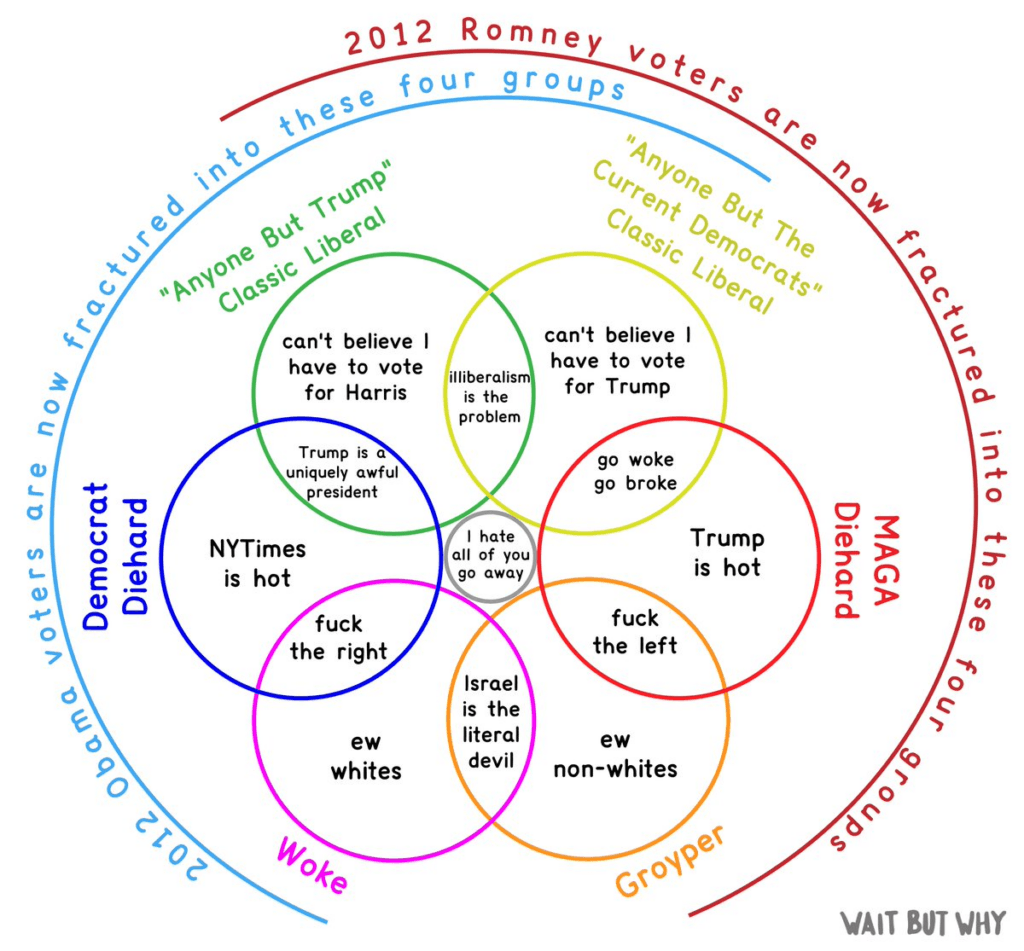
The following article is a good-faith exploration of the “Reluctant Trump Voter” (the person who sees themself in the yellow circle of Tim Urban’s excellent diagram belwow. I wrote this article not to “steelman” the President or ignore his flaws, but to examine the logic of the “Anyone But the Current Democrats” classic liberal. These voters are not MAGA; they are often deeply uncomfortable with Trump’s rhetoric but have concluded that the alternative represents a threat to American progress that is more subtle, but ultimately more harmful than Trump’s approach.
The Hero We Needed: A Good Faith Interpretation of the Trump Era
Many on the left are mystified by how a figure as polarizing as Donald Trump could be seen as a solution. But for a specific segment of the electorate, the “reluctant” voters, the choice isn’t about liking the man. It’s about a belief that the current system has become so calcified by bureaucracy and “expert-led” stagnation that only a disruptive force can break the gridlock.
The “Botanical Garden” Paradox: Resilient Systems vs. Bloated Rules
Natural systems are inherently resilient without a heavy hand. I love to visit the San Francisco Botanical Garden with my family. There are thousands of trees thriving in the garde, yet human behavior naturally chosa single “carving tree” where people have carved their names. No other trees are carved. People naturally understand some carving is OK on this one tree, it doesn’t spread. The system self-polices on its own.
The problems arise when experts intervene with well meaning but horribly inefficient ideas. In fact the worst thing by far in the Botanical garden when I visited was an absurd, 100 ft long concrete accessibility ramp through a grove of Chilean trees and plants, I guess it happened to be on a slghtly steep enough grade that it triggered a rule to replace the beautiful natural trail with a 4-foot high concrete handicap ramp in the middle of what was supposed to be a Chilean forest but now looked like a place to get on the Interstate.
- Real-World Example: This tension is visible in the current standoff between the administration and “Sanctuary Cities” like San Francisco and New York. While local leaders argue for community trust, the administration views these as “dead zones” that willfully violate federal law. They are dead zones because they are protected by virtue signaling. No poltician going to want to declare a city a NON-sanctuary city. It’s gridlocked. The administration has moved to withhold over $10 billion in federal funding from these jurisdictions to force compliance with national policy, a move currently being challenged in cases like San Francisco v. Trump.
Breaking the “Dead Zones”: The Power of Decisive Action
A central argument for the Trump presidency is the need for a strong executive to bypass “dead zones”. these are areas where systems have slowed to a crawl due to faulty design, bloat, or pessimism.
- The Immigration “Hack”: For years, a legal technicality allowed for mass illegal entry by requiring full due process for every deportation. In 2025, the administration leveraged Expedited Removals to bypass this judicial logjam.
- Speed over Theory (The Tariff Example): Borrowing from physicist John Wheeler, the goal is to “make mistakes as fast as possible.” Instead of endlessly debating theoretical fallout, Trump used a trial-and-error approach and took immediate action with a 10% universal tariff and a 20% tariff on Chinese imports. While economists predicted a global collapse, the reality has been a massive revenue injection—projected at $5.2 trillion over 10 years—which is being used to reduce federal debt and provide leverage in trade negotiations like the Kuala Lumpur Joint Arrangement.
Innovation via Elimination: The End of the “Incomplete Assignment”
To a traditional liberal on the left, a good solution looks like a smartly designed and well-funded program, possibly with its own slick website. But because the right focuses on removing blockers instead of creating new programs, to the left it often looks like they “handed in an incomplete assignment.” However, 2025 has shown more than a few breakthroughs come from clearing the brush. Here are a few examples:
- The 10-for-1 Rule: The administration’s “10-for-1” regulatory budget—requiring ten rules to be cut for every one added—has achieved $211.8 billion in net cost savings in its first year.
- Sector Examples: * Finance: The repeal of FinCEN’s beneficial ownership reporting requirement saved businesses $128.6 billion.
- Energy: By reversing the pause on LNG exports and propping up coal plants like Michigan’s J.H. Campbell through emergency orders, the administration is prioritizing immediate energy dominance over long-term theoretical climate goals.
- Tech: The “Genesis Mission” was launched to expedite permitting for AI data centers, stripping away environmental review barriers to ensure the U.S. wins the global AI race.
The “Department of Government Efficiency” (DOGE) and Radical Accountability
The establishment system prioritizes consensus, which often results in “Frankenstein policies” without clear owners or accountability. Trump’s approach, through DOGE, shifts the model toward individual accountability.
- DOGE in Action: The administration has moved aggressively to trim the federal workforce. DOGE effectively shuttered the Consumer Financial Protection Bureau (CFPB), cutting 1,480 employees, and announced $4 billion in cuts to NIH medical research to eliminate what it deems redundant or ideologically biased funding.
- Directness as Policy: The symbolic but potent move of restoring the “Department of War” (from the Department of Defense) signals a return to clear, direct objectives rather than bureaucratic euphemisms. While “rude” to some, this abrasive honesty is seen by reluctant voters as the only way to wake up a stagnant system.
Conclusion: Beyond the Vibe
Ultimately, the reluctant Trump voter is trading “vibes” for results. They see the Democratic “dead zones” in cities like San Francisco, where community input leads to infinite gridlock for new housing and transportaion, and fear that future for the country.
Trump is not a “conservative” in the traditional sense; he is a catalyst for destructive creation. By choosing a leader who takes “big swings,” these voters are betting that a little bit of chaos is a small price to pay for the return of American exceptionalism and the breaking of a system that had forgotten how to move forward. The biggest victory of the second Trump presidency would be if large numbers of people realize they can break free of system based, community-input style thinking and become dynamic individual contributors to our country.