I’ve gotten some reactions from people who have sort of “midwit” interpreted some of my past writing as anti-AI, but that is completely wrong and I love using AI and I think it’s great.
What I’m saying is actually a very pro-human idea, which is I think AI will actually prompt people to learn to be more creative and do more infinite world type thinking (which they have always been able to do, but have settled on finite world thinking for various reasons which I’ll describe below).
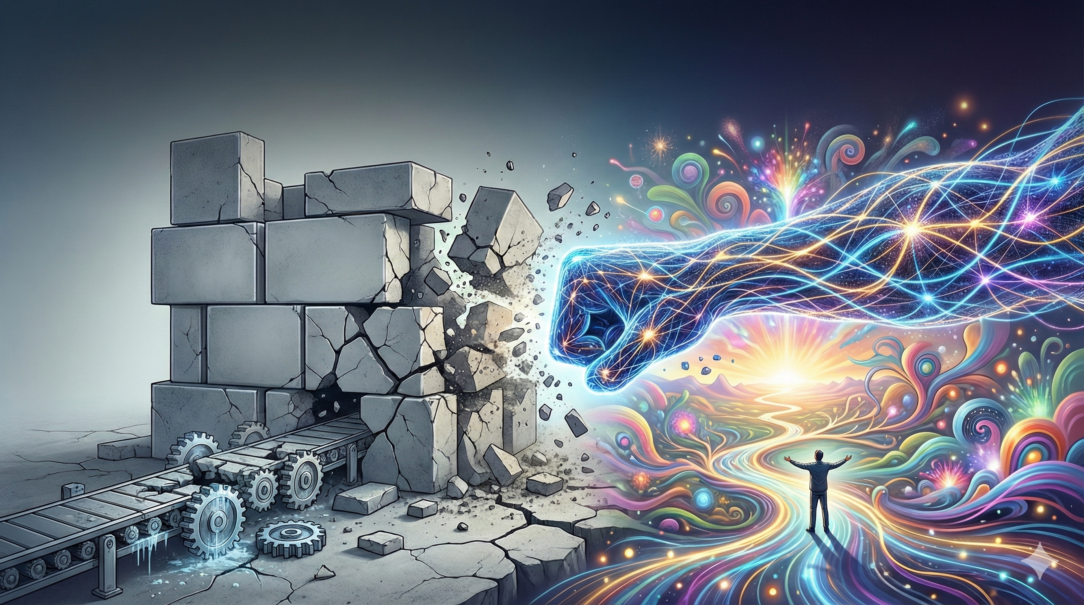
Finite world is things like coding where value comes from pattern matching or “doing it the right way”. It’s not creative work so much as finding the right existing formulas and piecing them together. Like brute forcing a puzzle by testing a bunch of pieces until you find the combination that works. Then doing the same puzzle faster next time because you learned which pieces go where.
But the world is not a puzzle. The picture is always changing and there are new pieces being created all the time.
Infinite world is infinite possibilities, pattern breaking aka “finding new creative ways to do it”.
Finite worlds are closed systems of logic, and most software developers spend 99% of their time wrestling with that part. That is the part of work that is ripe for automation. It would be like if your job was mostly to build spreadsheets. This is something a computer is very good at. Also why computers can do things like protein folding very well.
The marketing equivalent of finite world thinking would be if you’re the type who thinks your job is mostly to tell the client what the “best practices” are and then just deliver that. You think of yourself like a gatekeeper of knowledge, which was never a great way to operate but is now getting more obsolete.
Why Uncreative Work is So Pervasive
People settle into uncreative work and “finite world” thinking not because they lack imagination, but because our systems are built to reward it. Here are a few reasons why that mindset is the default:
1. The Industrial Assembly Line Legacy
Most modern work environments are built like factories. In a factory, creative/infinite world thinking is actually a defect. If a worker tries to be creative with how they attach a car door, the assembly line breaks.
- Primary goal is predictability/repeatability.
- We’ve spent 150 years training humans to be order takers and pattern matchers. Coding, “best practice” marketing, and a lot of your job became the high-rent versions of this same assembly-line logic.
2. Risk Mitigation and the the Comfort of Being “Right”
Finite worlds are safe because they have a “Right Answer.”
- In a closed system (like a codebase or a spreadsheet), there are a limited number of options and you can select one that is objectively correct.
- In an infinite world, what matters is effectiveness at achieving or even redefining a goal, which is subjective and carries the risk of failure. People default to finite thinking because you can’t get fired for following a “best practice,” even if that practice does not produce a competitive edge.
3. It’s Hard to Think Divergently
Pattern matching (finite) is energetically cheap for the brain. Pattern breaking (infinite) requires divergent thinking, which is metabolically expensive and mentally taxing.
- Finite: “How do I fill all the square holes with square pegs?”
- Creative/Infinite: “Why pegs? What type of fastener would work best to get the outcome we want? If it does not exists how can I create it?”
4. The Education System Ruins Peoples’ Creativity
From kindergarten through university, success is defined by how well you navigate a finite system.
- Standardized tests are the ultimate finite world: a closed set of knowledge with a singular path to a 4.0 GPA.
- When people enter the workforce, they continue to look for the “syllabus” (the set of tasks that, if completed, guarantees a reward).
5. Gatekeeper Ego
People often derive their self-worth from information asymmetry.
“I know the secret formula, and you don’t.”
When AI democratizes that information, the “gatekeeper” feels threatened. To move into infinite thinking, they have to admit that their “secret knowledge” was actually a commodity all along.
Finding an Edge in the AI Era
If everyone has access to the same infinitely productive intern (AI), then the level of output rises, but the differentiation of that output drops to zero. This means your productivity growth (your career) is bounded if you rely solely on AI to do your job.
So while most people frame their thoughts on AI as some for of “can this do X set of tasks yes/no”, they should think about it differently. I’ll use a marketing example since that’s my industry, but you can swap in your own…if Brand A uses AI for a particular marketing function. And Brand B uses it for that same function, where can each brand find an edge in the market? Both must still satisfy the requirements, but to win they must find something outside of the existing body of knowledge (outside the AI), which is how people have always made progress, invented new things, etc. But instead of creativity being something geniuses do rarely, it will have to become something we all do regularly.

I run a boutique SEO consulting business in San Francisco, CA. I like to play golf, write a little bit, and argue with my friends.